
The Love Triangle Spread
Difficulty: Complicated
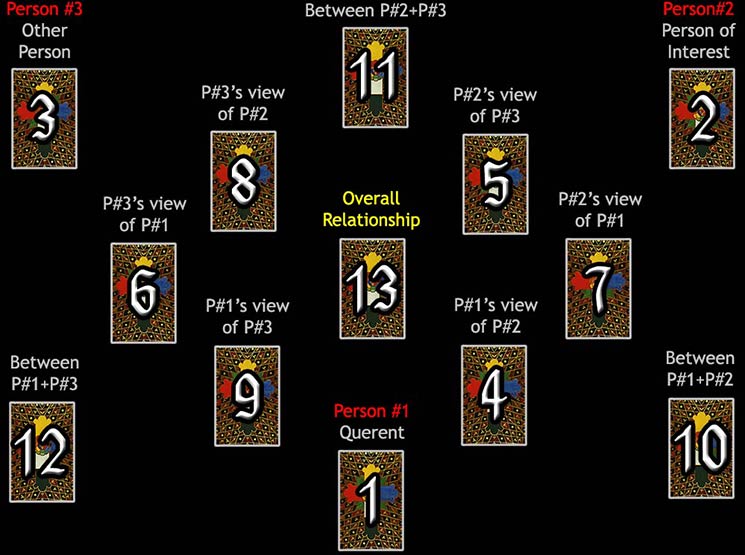
Casually referred to as the Love Triangle, this spread can be used to determine the dynamics of the relationship between three people, regardless of whether romance is involved. This spread is arranged in the form of a hexagram, consisting of several large and small triangles. This tarot spread may seem somewhat complicated, but it is not entirely that difficult.
The first step is to interpret the card for each individual position in the spread. Generally, one might ask about a relationship they are involved in, but this does not have to be the case. Ordinarily, the reader's representative card is #1, their main person of interest is #2, and the other person would be #3.
The second step fills in the downward triangle and involves further examination of the individuals through their views of the other people. Each person has two more cards showing the way they see and relate to the other members of the triangle. For example, Card #6 indicates how Person #3 relates to Person #1, while Card #9 stands for Person #1's attitude toward Person #3.
The next step completes the upward triangle and the hexagram, focusing on cards #10–13. It also completes the many smaller triangles and hints at the potential for each relationship. The final card, #13 can be considered the significator of the reading, which suggests the overall potential for this three-way relationship.
Your Love Triangle Reading
| P#3 | 3to2 | 2+3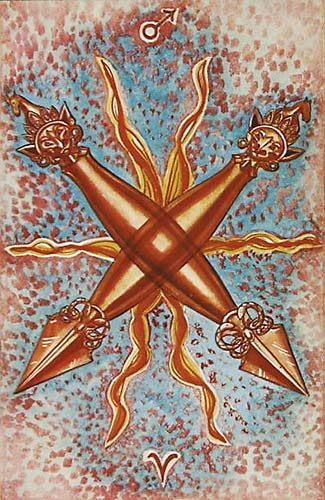 |
2to3 | P#2 | ||
 |
3to1 | 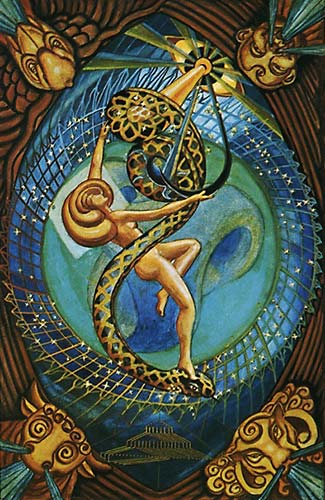 |
Overall | 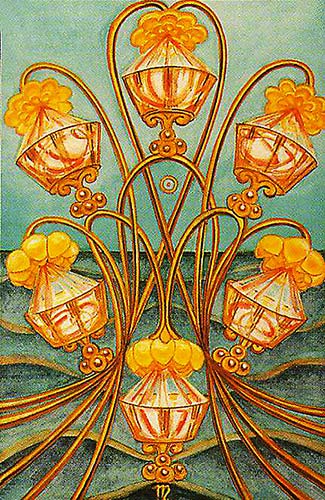 |
2to1 | 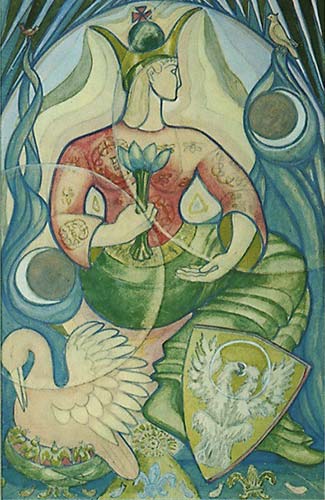 |
| 1+3 | 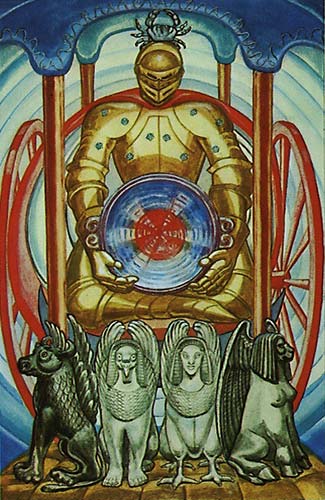 |
1to3 | 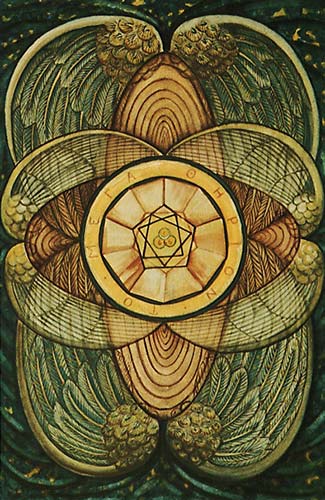 |
1to2 | 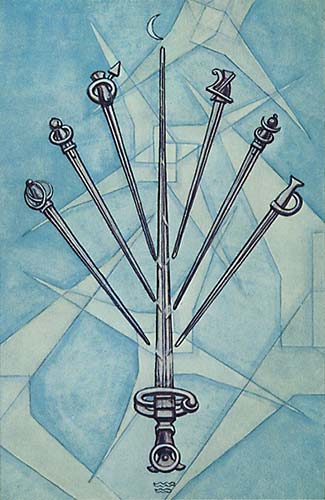 |
1+2 |
 |
 |
P#1 | 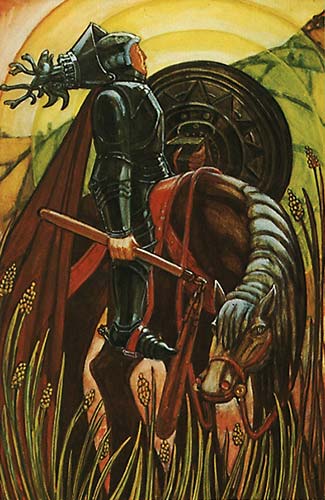 |
 |
||
 |
1: Person #1
Astrological Correspondence: Sun in Capricorn
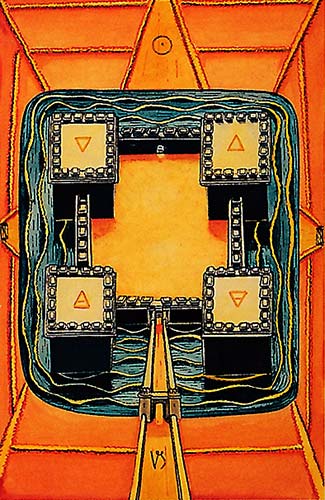
The Four of Disks (Power) represents the solidification and consolidation of material wealth and security. The imagery of four square disks arranged symmetrically evokes stability, emphasising the creation of a solid foundation and the control one has over their material circumstances. This card symbolises the mastery and protection of financial resources and the ability to maintain power and stability in the physical world.
The Four of Disks reflects a time when material security is established, and you are likely in a position of control over your material situation. It highlights the importance of maintaining discipline, focus, and practicality in securing one's wealth, but also warns against the potential rigidity or over-attachment to material possessions. The influence of the Sun in Capricorn encourages a steady, strategic approach to building and preserving wealth, ensuring that power and stability are achieved through responsible, enduring effort. This card represents a moment of mastery in managing one's material world.
In Relationships: The Four of Disks may signify stability and security but can also indicate possessiveness or control. It may suggest that you are focusing on maintaining the material aspects of a relationship, such as financial security, at the expense of emotional depth or freedom.
In Work: The Four of Disks suggests financial stability and control over one's material resources. It indicates success in business or career, particularly through careful management and conservation of resources. The card advises maintaining control and not taking unnecessary risks with financial matters.
Spiritually: The Four of Disks may suggest that you are focusing too much on the material or outward manifestations of spirituality and not enough on inner growth. It may be a reminder to let go of the need for control and allow more freedom and flow in your spiritual practice.
When ill-dignified: The Four of Disks represents a fixation on materialism, greed, or possessiveness. You may be too conservative with your resources, unable to let go of control. It can indicate insecurity masked by an outward appearance of power, or the inability to adapt to changing circumstances.
2: Person #2
(Venus, Daleth)
The Empress is a vibrant manifestation of fertility, creativity, and the nurturing power of love. Associated with Daleth, the door, she represents the gateway to abundance and the generative forces of the divine feminine. Venus, the planet of beauty and harmony, infuses her with grace, sensuality, and the power to create life and art in all forms.
The imagery of The Empress radiates lushness and vitality. She is enthroned amidst a verdant paradise, symbolising her role as the Earth Mother. Her gown flows in harmonious patterns of red, green, and gold, adorned with pomegranates—a symbol of fertility and the mysteries of creation. In her right hand, she holds a lotus flower, representing purity and spiritual unfolding. At her feet rests a shield emblazoned with an alchemical double eagle. She gazes at a dove, a symbol of the Holy Spirit, while the aura around her suggests industrious creativity and the interconnectedness of life.
In Relationships: The Empress signifies profound connection, nurturing energy, and the blossoming of relationships. She encourages you to cultivate love with patience and care, allowing it to flourish naturally.
In Work: This card indicates a fertile period for creativity and growth. You are encouraged to trust your creative instincts and nurture your projects with love and dedication, knowing abundance will follow.
Spiritually: The Empress represents the divine source of life and the sacred connection to nature. She calls you to honour your creative power and embrace the beauty and abundance within and around you.
When ill-dignified: The Empress warns of stagnation, overindulgence, or smothering tendencies. You are advised to examine whether your actions are rooted in genuine love or in a need to control and ensure you are not sacrificing yourself for others.
3: Person #3
Astrological Correspondence: Moon in Cancer
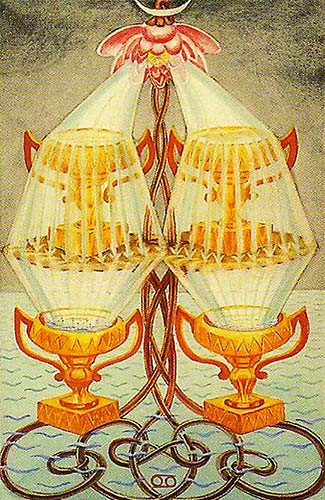
The Four of Cups, or Luxury, represents the fulfilment and abundance that comes with emotional satisfaction and the enjoyment of what is already in one's life. It symbolises emotional contentment, where you can reflect on what has been achieved and the blessings already received.
The card features four cups arranged in a square formation, with light flowing from the top two cups down into the bottom two. This light represents the emotional flow of abundance and fulfilment, symbolising the harmonious exchange of emotions. The imagery conveys a moment of emotional reflection, where you recognise the blessings in your life and enjoy a sense of gratitude and stability. The Four of Cups invites you to acknowledge the wealth of emotional experiences and satisfaction you have gained, encouraging you to savour and appreciate the emotional contentment you have achieved.
In Relationships: The Four of Cups may indicate emotional dissatisfaction, disillusionment, or boredom in the relationship. You may be so focused on disappointments or unfulfilled desires that you do not recognise new possibilities or opportunities for emotional connection.
In Work: Professionally, this card suggests a feeling of emotional or creative stagnation. You may feel unfulfilled by your work or uninspired by your current role. There may be dissatisfaction, and you may need to seek new challenges or engage in deeper introspection to reconnect with your passion and purpose.
Spiritually: The Four of Cups suggests emotional withdrawal or spiritual apathy. You may be disconnected from your spiritual path, lost in self-doubt, or focused on past disappointments. The card invites you to open your heart to new possibilities and reconsider what might be missing in your spiritual practice.
When ill-dignified: The Four of Cups may point to a state of emotional block or closed-off behaviour. You may be emotionally repressed, unwilling to confront or process your feelings. There may be a tendency to dwell in negativity or missed opportunities, leading to a cycle of dissatisfaction that is hard to break.
4: Person #1's view of #2
Element: Fire of Earth
Astrological Correspondence: Aquarius
The Knight of Disks represents the dynamic, action-oriented force within the Earth element, focused on practical innovation and intellectual transformation. The Knight is depicted riding a horse, stopped in a field ripe for harvest, symbolising his thoughtful yet purposeful approach to change. Unlike other Knights fuelled by raw energy, the Knight of Disks harnesses a clear vision that guides his methodical actions in the material world.
His element, Fire of Earth, signifies the application of passionate, transformative energy to the practical, grounded realm of materiality. The Knight of Disks is driven by the intellectual spark that ignites new ideas, and he can bring those ideas into tangible form, manifesting lasting change. His actions are grounded in practicality, and his innovative thoughts challenge the status quo while ensuring they are feasible and rooted in the physical world.
This card encourages us to think creatively, apply new solutions with a solid, practical foundation, and transform the material realm through intellect and purpose. The Knight of Disks teaches that change can be achieved through thoughtful, intentional actions that balance idealism with grounded reality.
In Relationships: The Knight of Disks can indicate a partner who is intellectual, innovative, and has a vision for the future. He may bring new ideas or approaches to a relationship, often seeking to create stability through innovation. However, the Knight of Disks may also point to a relationship where intellectual connection is prioritised over emotional intimacy.
In Work: The Knight of Disks suggests someone who is a visionary and can apply new ideas to achieve material success. It indicates a time when intellectual work and practical application can yield significant results. The card encourages thinking outside the box but in a way that is grounded in reality.
Spiritually: The Knight of Disks represents pursuing new ideas and knowledge. It encourages you to explore innovative approaches to spiritual practice while maintaining a grounded, practical approach. The Knight represents intellectual clarity and the application of new concepts in your spiritual journey.
When ill-dignified: The Knight of Disks can indicate a lack of flexibility or a rigid, dogmatic approach to life. You may be overly focused on material gain or be unwilling to consider new perspectives or approaches. There may also be an overreliance on intellectual reasoning at the expense of emotional or spiritual insight.
5: Person #2's view of #3
Astrological Correspondence: Sun in Scorpio
The Six of Cups symbolises harmony, emotional fulfilment, and glee derived from experiences or connections. In this deck, the card features six golden cups arranged in a balanced and symmetrical pattern, overflowing with water from flowers, representing the renewal and richness of emotional energy. The imagery conveys an atmosphere of sensual satisfaction and the revitalising joy of revisiting memories or tapping into emotional resources from the past.
The Sun in Scorpio combines the warmth and illumination of the Sun with Scorpio's depth and intensity, highlighting a connection between the conscious acknowledgment of joy and the transformative power of emotional experiences. It signifies a moment of emotional harmony where the past serves as a source of strength and inspiration for the present.
The Six of Cups invites us to indulge in the pleasures of memory and connection, celebrating the richness of our emotional life. While it carries echoes of nostalgia, it is not merely a backward glance but an affirmation of the deep well of emotional abundance that fuels growth and joy. It reminds us to embrace moments of pleasure, allowing them to recharge our spirits and enrich our present.
In Relationships: The Six of Cups can suggest a reunion with a past lover or rekindling of childhood affection or relationships that hold emotional nostalgia. It may also indicate a period of emotional healing, where you can find solace in the purity of love once experienced or remembered.
In Work: The Six of Cups might represent revisiting passions, returning to work or environments where you once found emotional fulfilment. This card suggests drawing on experiences or revisiting a childhood dream or ambition could help bring growth and emotional satisfaction in your career.
Spiritually: The Six of Cups speaks to a desire for a return to spiritual innocence and simplicity. It can be a reminder to embrace the spiritual joy and wonder of childhood or early spiritual experiences. It may also indicate a time to reconnect with old spiritual practices that once felt powerful, or to seek comfort in sacred places or rituals.
When ill-dignified: The Six of Cups may point to excessive attachment to the past, nostalgia for things that no longer serve you. There may be a reluctance to move forward, clinging to former relationships or times with an unrealistic expectation. You may feel stuck, as if you are living in the past and unable to embrace the present or future.
6: Person #3's view of #1
(Cancer, Cheth)
The Chariot represents triumph through willpower, discipline, and the unification of opposing forces. Associated with Cheth, the fence, it symbolises both protection and the boundaries that define and direct progress. Cancer, the zodiac sign of emotional depth and intuition lends the card its nurturing energy, ensuring that strength is tempered with compassion.
The Charioteer is a figure of regal composure, encased in golden armour and standing within a shell-like chariot. This shell evokes the protective qualities of Cancer, while the armour signifies spiritual and emotional fortitude. In his hands, he holds the Holy Grail, a symbol of divine purpose and spiritual attainment. The four sphinxes that draw the chariot—two white and two dark—represent the dual forces of light and darkness, which the Charioteer must master to move forward. The canopy above him is adorned with stars, linking his journey to celestial guidance and higher aspirations.
In Relationships: The Chariot indicates a relationship that requires balance and mutual effort to succeed. It suggests overcoming obstacles through shared determination and a focus on common goals.
In Work: This card signifies victory achieved through discipline, focus, and the ability to steer conflicting forces towards a unified purpose. You are encouraged to remain steadfast and clear in your intentions.
Spiritually: The Chariot represents the journey of the soul towards higher awareness, guided by the alignment of will and intuition. It calls you to embrace your inner strength and move forward confidently.
When ill-dignified: The Chariot warns of a loss of direction, internal conflict, or reckless ambition. You are advised to reassess your goals and ensure you are not being led astray by conflicting desires or external pressures.
7: Person #2's view of #1
Astrological Correspondence: Moon in Aquarius
The Seven of Swords features six swords pointing downward, surrounding one large, central sword. The swords' arrangement creates a sense of imbalance, indicating confusion, strategy gone awry, or mental conflict. The large sword in the centre represents a central issue or challenge, while the six surrounding swords suggest attempts at intellectual or strategic action that fail to resolve the problem.
The Moon in Aquarius influence brings emotional confusion or distorted perceptions, where rational thought may be clouded by fears or hidden motives. This card points to the futility of relying solely on cleverness or deceit to solve problems. Instead, it urges you to face the situation directly, as manipulation is unlikely to bring lasting resolution.
The Seven of Swords warns of misdirected efforts, cautioning you to know the consequences of trying to escape or avoid the truth through deceit or cunning. It signals a time of reassessment, urging a clearer, more honest approach to mental challenges.
In Relationships: The Seven of Swords may suggest dishonesty, hidden motives, or the need for careful communication. It could indicate that one partner is concealing something important, or a relationship is built on mind games. The card calls for transparency and openness to avoid betrayal or misunderstanding.
In Work: The Seven of Swords may indicate that you are using strategy, perhaps even deceit, to achieve success. It suggests a need to be cautious of the ethics of your actions, as victory gained through dishonesty can be short-lived. Alternatively, the card may indicate a situation where you are being strategic, working behind the scenes to plan for future success.
Spiritually: The Seven of Swords indicates a need for discernment and caution. It may signify a situation where you are hiding your true spiritual intentions or are not being entirely honest with yourself. The card urges you to confront secrets or falsehoods to achieve spiritual clarity.
When ill-dignified: The Seven of Swords can signify outright deception, manipulation, or betrayal. It can also point to avoidance of the truth or a tendency to hide behind false pretences. This card warns against the misuse of intellect for personal gain, urging you to reconsider the ethics of your actions and motivations.
8: Person #3's view of #2
(Saturn, Earth, Tau)
The Universe is the culmination of the journey, symbolising integration, completion, and the harmonious union of opposites. Associated with Tau, the cross, this card reflects the materialisation of divine will and the synthesis of all forces. Saturn, the planet of structure and discipline, anchors the card in themes of order and manifestation.
The central figure is a nude woman, symbolising the perfected self, dancing within a ring of stars, on the head of an enormous serpent. She holds tools of creation in her hands, embodying mastery over all elements. Around her, the four cherubim faces—the lion, the eagle, the man, and the bull—represent the fixed signs of the zodiac and the balance of cosmic forces, as water flows from their noses and mouths. The background represents the infinite possibilities of the universe.
In Relationships: The Universe signifies fulfilment and the realisation of harmony. It encourages you to celebrate the unity and wholeness of your connections.
In Work: This card indicates the successful completion of a cycle and the achievement of long-term goals. You are advised to reflect on your accomplishments and prepare for new horizons.
Spiritually: The Universe symbolises enlightenment, the integration of all aspects of the self, and the realisation of cosmic unity. It calls you to embrace your place within the greater whole and celebrate the infinite potential of existence.
When ill-dignified: The Universe warns of stagnation, fear of completion, or an unwillingness to move forward. You are advised to release resistance and trust in the cycles of growth and transformation.
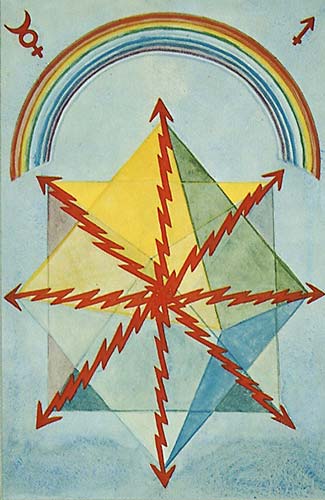
9: Person #1's view of #3
Astrological Correspondence: Mercury in Sagittarius
The Eight of Wands represents rapid movement, clarity, and the acceleration of progress towards a goal. The card depicts eight wands arranged in a balanced, geometric pattern, with bolts of lightning radiating outward to emphasise speed and precision. Mercury, the planet of communication and intellect, combines with Sagittarius' expansive, forward-moving energy, creating swift momentum and purpose.
This card signifies the culmination of processes that have been set into motion, where obstacles are cleared and events unfold quickly. It reflects clarity, the alignment of ideas, and the efficient execution of plans. The Eight of Wands encourages you to remain focused and adaptable as opportunities arise and situations evolve rapidly. It is a card of dynamic energy, progress, and the swift resolution of matters.
In Relationships: The Eight of Wands signals rapid developments. This could be the fast movement of a romantic connection, where things move forward at an exciting pace. It suggests a period of enthusiasm, with events unfolding quickly.
In Work: This card indicates a time of swift progress and advancement. Opportunities and breakthroughs are moving rapidly, and you should be prepared to act quickly to seize them. It represents momentum and a time of positive growth.
Spiritually: The Eight of Wands suggests you are about to experience a rapid shift or insight. Things are moving quickly in your spiritual journey, and you should be open to the rapid flow of inspiration, growth, or change.
When ill-dignified: The Eight of Wands may signify haste or impulsivity, suggesting that you are rushing into something without adequate preparation or thought. It could also indicate a lack of direction, where events are moving too fast for you to maintain control. It advises slowing down and reassessing the situation before proceeding.
10: Overall relationship between persons #1 and #2
Astrological Correspondence: Jupiter in Leo
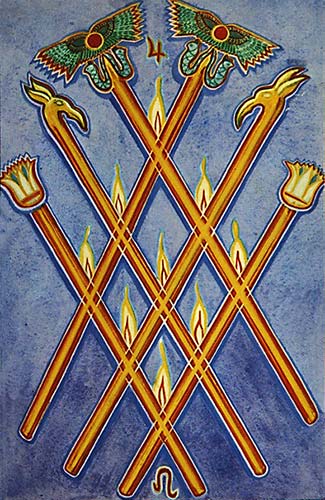
The Six of Wands represents triumph, success, and the confidence that comes with achieving a hard-won victory. The card features six wands arranged in a harmonious and balanced pattern, radiating energy and stability. Flames burn brightly at the intersections, symbolising the dynamic, victorious energy of Jupiter's expansive influence paired with Leo's bold, charismatic nature.
This card signifies the rewards of perseverance and effort, along with the recognition of those achievements by others. It is a moment of celebration and validation, where personal success aligns with public acknowledgment. The Six of Wands also reflects the importance of leadership, generosity, and using one's influence to uplift and inspire others. It encourages you to savour your accomplishments while remembering the responsibility that comes with triumph.
In Relationships: The Six of Wands indicates positive recognition. There may be a public celebration of a commitment or the successful overcoming of obstacles. It represents mutual admiration and respect.
In Work: This card signifies a well-earned victory in professional life. You may receive praise, promotion, or recognition for your efforts. It suggests your hard work has been acknowledged, and you are on the path to greater achievements.
Spiritually: The Six of Wands represents a moment of spiritual triumph. It indicates that you have navigated challenges and are now reaping the rewards of your efforts. It is a time of affirmation and confirmation of your spiritual path.
When ill-dignified: The Six of Wands may indicate a hollow or fleeting victory. It can also suggest pride, arrogance, or overconfidence in the face of achievement. You might focus too much on external validation rather than the deeper satisfaction of personal growth. It cautions against becoming self-important.
11: Overall relationship between persons #2 and #3
Astrological Correspondence: Mars in Aries
The Two of Wands, subtitled Dominion, represents the fiery energy of Mars in Aries. It symbolises the dynamic assertion of will, confidence, and the power to take control. The card depicts two crossed wands, each topped with ram heads, symbolising Aries' fiery, pioneering energy. Flames emanate from the wands, emphasising the active, forceful nature of this card. This card is about asserting dominance and taking decisive action. It reflects an intense drive to establish control over one's environment and push forward boldly. It is a card of raw, active energy, demanding focus and determination.
In Relationships: The Two of Wands indicates the need to make decisions about the future of a relationship. It represents contemplating the potential paths ahead, whether to deepen the connection or to explore new opportunities.
In Work: This card signifies a choice or decision that must be made regarding one's professional life or creative pursuits. You are encouraged to look beyond the immediate horizon and assess which path will bring the greatest fulfilment.
Spiritually: The Two of Wands symbolises the crossroads of spiritual growth. It suggests a time of decision, where you must choose the direction you will take on your spiritual journey.
When ill-dignified: The Two of Wands may indicate indecision, stagnation, or a lack of commitment. You might be overwhelmed by choices or hesitant to take action. It advises you to focus and take decisive steps to move forward.
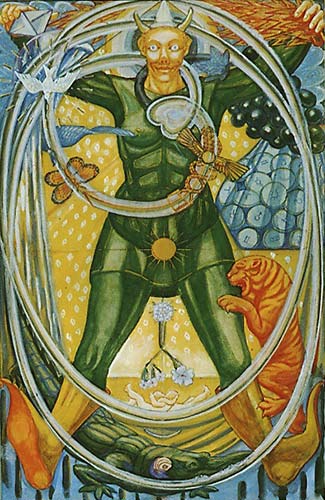
12: Overall relationship between persons #1 and #3
(Air, Uranus, Aleph)
The Fool of the Thoth deck embodies the chaotic, boundless energy of pure potential, untouched by form or limitation. He is the alpha and omega of the journey, the primordial force from which all creation arises. Corresponding to Aleph, the breath of life, and the element of Air, the Fool represents the vibrant, unpredictable nature of Uranus, the planet of sudden change and divine inspiration.
The figure of The Fool is richly adorned, standing amid a swirling maelstrom of symbolic forms. He wears motley robes to represent his openness to all experiences, while the winged sun at his feet symbolises the life-giving power of the divine. Around him whirl a tiger (representing instinct and primal fear), a crocodile (a guardian of the mysteries and a symbol of time), and a rainbow-hued disk, representing the harmony of all elements. The Fool holds a blazing torch in one hand and a crystal cup in the other, signifying the balance of will and receptivity. One foot is grounded in the world, while the other stands on the fourth wall, as if attempting to step into our world.
In Relationships: The Fool represents the potential for new beginnings and uncharted emotional experiences. It encourages you to approach relationships with innocence and trust, unburdened by fears or preconceptions.
In Work: This card advises bold action and faith in one's ideas. It suggests venturing into unfamiliar territory and taking inspired risks, understanding that growth lies in embracing uncertainty.
Spiritually: The Fool symbolises the seeker's initial step on the path to enlightenment, an act of surrender to the cosmic current. It urges you to trust the process and let go of the need for certainty.
When ill-dignified: The Fool warns of chaos, recklessness, or naivety. You are cautioned to discern whether you are pursuing freedom or fleeing responsibility and examine whether your actions align with higher wisdom.
13: Overall 3-way Relationship
(Root of Earth)
The Ace of Disks represents the raw, unmanifested potential of the physical world. At the centre of the card lies a single disk, surrounded by a swirling energy that symbolises the seed of all material manifestation. This image reflects the potential for creating wealth, stability, and physical well-being. The Ace of Disks marks the initiation of a new cycle in the realm of material affairs, a beginning full of possibility and grounded in the Earth element.
This card embodies the promise of prosperity and abundance, signifying the fertile ground from which tangible results will grow. It suggests you are on the brink of a new opportunity that has the potential for lasting growth and concrete success. The Ace of Disks is a symbol of manifestation, inviting the energy of physical reality to align with your intentions, and pointing to the importance of patience, effort, and practical action in bringing desires into the material world.
In Relationships: The Ace of Disks represents a new, stable foundation for a relationship. It suggests a relationship could be grounded in the material realm, such as sharing resources, practical concerns, and tangible commitments. It is a positive sign for the long-term potential of a relationship if both partners are willing to invest in it practically and thoughtfully.
In Work: The Ace of Disks signifies the beginning of a new venture or enterprise with the potential for incredible material success. It suggests a strong foundation is being laid, and this card heralds new opportunities to make money or build a business. It encourages focusing on long-term goals and being practical in your approach to success.
Spiritually: This card represents grounding one's spiritual practice into the physical realm. It suggests a connection between the material and spiritual worlds, where the material world reflects the spiritual, and vice versa. The Ace of Disks invites you to manifest your spiritual insights in the physical world and recognise the divine in all things material.
When ill-dignified: The Ace of Disks can indicate missed opportunities in material matters or the failure to capitalise on available resources. There may be a reluctance to invest time and energy into practical affairs, or an inability to manifest your desires in the physical realm. It could also represent greed or an overemphasis on materialism at the expense of spiritual growth.