
Blind Spot Spread
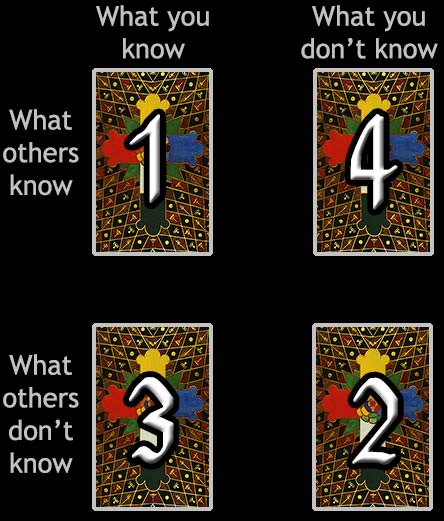
Difficulty: Varies
This tarot spread is used to enhance self-awareness. Questions about learning something about oneself or things that are hidden work very well with this tarot spread, although no question is necessary.
- This tarot card displays the obvious identity, the part of oneself that is consciously known and projected to others.
- This card indicates unconscious driving forces that neither the reader nor others are aware of about them, the great unknown. Nobody knows what this tarot card means, at least not yet...
- The part of oneself that is concealed, to keep others from discovering, is apparent in this card.
- This is the Blind Spot. This is what was asked about, that which this reading should bring awareness of. The reader may wish to pay close attention to these mannerisms.
Your Blind Spot Reading
| What you know | What you don't know | |
| What others know | 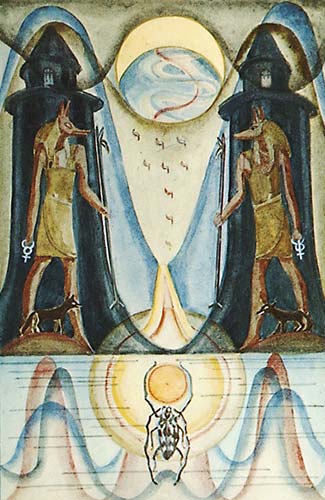 XVIII – The Moon |
 Nine of Wands (Strength) |
| What others don't know | 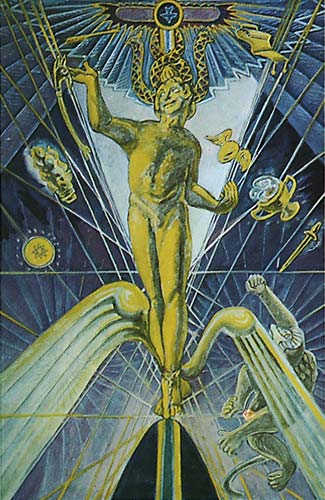 I – The Magus |
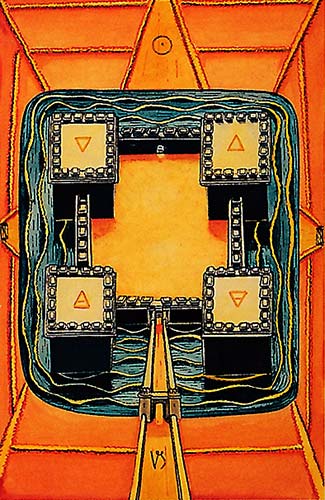 Four of Disks (Power) |
This card displays your obvious identity, the part of you that everyone knows.
XVIII – The Moon
(Pisces, Qoph)
The Moon symbolises illusion, intuition, and the mysterious depths of the subconscious. Associated with Qoph, the back of the head, this card delves into the primal and instinctual aspects of the psyche. Pisces, the zodiac of dreams and mysticism, enhances the card's themes of mystery and emotional depth.
The imagery is haunting and enigmatic. A path winds through barren terrain, flanked by twin towers that suggest gateways to the unknown. Above, the moon dominates the sky, casting an eerie light that obscures as much as it reveals. Crawling on the path is a scarab beetle carrying the solar disk, symbolising the emergence of light from darkness. The waters below teem with life, representing the fertile chaos of the subconscious.
In Relationships: The Moon represents emotional complexity and hidden dynamics. It encourages you to trust your intuition and uncover underlying truths.
In Work: This card suggests uncertainty or confusion. You are advised to navigate carefully, relying on intuition and patience to discern the best path forward.
Spiritually: The Moon symbolises the journey through the subconscious and the mysteries of the soul. It calls you to explore your inner depths and embrace the wisdom found in dreams and intuition.
When ill-dignified: The Moon warns of deception, confusion, or fear of the unknown. You are advised to confront your fears and seek clarity amidst uncertainty.
This card shows unconscious driving forces that neither you nor your company is aware of about you. This is the Great Unknown.
Four of Disks (Power)
Astrological Correspondence: Sun in Capricorn
The Four of Disks (Power) represents the solidification and consolidation of material wealth and security. The imagery of four square disks arranged symmetrically evokes stability, emphasising the creation of a solid foundation and the control one has over their material circumstances. This card symbolises the mastery and protection of financial resources and the ability to maintain power and stability in the physical world.
The Four of Disks reflects a time when material security is established, and you are likely in a position of control over your material situation. It highlights the importance of maintaining discipline, focus, and practicality in securing one's wealth, but also warns against the potential rigidity or over-attachment to material possessions. The influence of the Sun in Capricorn encourages a steady, strategic approach to building and preserving wealth, ensuring that power and stability are achieved through responsible, enduring effort. This card represents a moment of mastery in managing one's material world.
In Relationships: The Four of Disks may signify stability and security but can also indicate possessiveness or control. It may suggest that you are focusing on maintaining the material aspects of a relationship, such as financial security, at the expense of emotional depth or freedom.
In Work: The Four of Disks suggests financial stability and control over one's material resources. It indicates success in business or career, particularly through careful management and conservation of resources. The card advises maintaining control and not taking unnecessary risks with financial matters.
Spiritually: The Four of Disks may suggest that you are focusing too much on the material or outward manifestations of spirituality and not enough on inner growth. It may be a reminder to let go of the need for control and allow more freedom and flow in your spiritual practice.
When ill-dignified: The Four of Disks represents a fixation on materialism, greed, or possessiveness. You may be too conservative with your resources, unable to let go of control. It can indicate insecurity masked by an outward appearance of power, or the inability to adapt to changing circumstances.
The secrets you keep from others are shown by this card.
I – The Magus
(Mercury, Beth)
The Magus of the Thoth deck radiates dynamic energy, the force of will and intellect that shapes reality. He corresponds to Beth, the house, signifying the power to create structure and form. Governed by Mercury, the Magus represents the mastery of communication, skill, and adaptation, embodying the ability to transmute thought into action.
The Magus stands amidst the elements he commands. Around him swirls the wand, cup, sword, and disk, each imbued with vibrant, electric energy. His figure exudes movement and control, as though he exists in a state of constant creation. Above him, the winged caduceus—the rod of Hermes—rises as a symbol of unity and transformation. The beam connecting heaven and earth signifies the infinite cycle of energy and potential.
In Relationships: The Magus suggests magnetic attraction and the ability to manifest deep, meaningful connections. It emphasises the importance of clear communication and aligning intentions with actions to nurture relationships.
In Work: This card signifies mastery and the ability to manifest success through focus and skill. It advises you to harness your talents and act with precision and intention to achieve your goals.
Spiritually: The Magus represents the awakening of personal power and the alignment of the microcosm and macrocosm. It is a call to take responsibility as a conscious creator in the divine play of existence.
When ill-dignified: The Magus warns of manipulation, overconfidence, or a scattering of energy. You are urged to examine your motives and ensure your actions serve the highest purpose, avoiding the temptation to misuse your gifts.
This is your Blind Spot. This is what you asked about – what you wished to be made aware of by this reading.
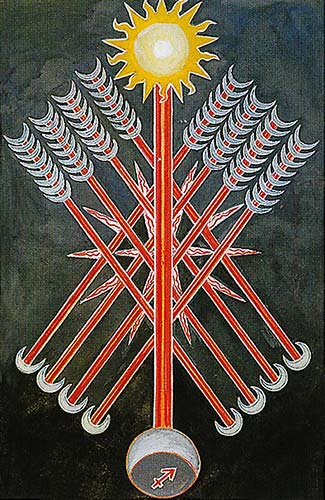
Nine of Wands (Strength)
Astrological Correspondence: Moon in Sagittarius
The Nine of Wands represents resilience, inner strength, and the perseverance needed to overcome challenges. This card features nine wands arranged in a structured yet dynamic pattern, radiating energy and determination. The Moon brings intuition, emotional depth, and adaptability, while Sagittarius contributes an optimistic and expansive drive, resulting in a card that embodies enduring strength amidst adversity.
This card signifies the ability to push forward despite difficulties, maintaining resolve and focus even when the path is arduous. It reflects the culmination of effort, where one has faced many battles and emerged stronger, though perhaps weary. The Nine of Wands encourages you to trust your instincts, remain vigilant, and protect what you have worked hard to achieve. It is a reminder that the final stretch of a challenge requires courage and unwavering determination.
In Relationships: The Nine of Wands represents a period where you may feel guarded or defensive because of experiences. It suggests a time of emotional resilience, where you are protecting the relationship or your heart but still willing to continue fighting for love.
In Work: This card indicates that you have faced many obstacles in your career or pursuits and are now standing strong, prepared to face any further challenges. It calls for perseverance and the belief that you can overcome any remaining difficulties.
Spiritually: The Nine of Wands speaks to spiritual endurance. You may have gone through difficult periods in your spiritual path but have come out stronger. This card encourages you to remain vigilant and steady as you continue your journey.
When ill-dignified: The Nine of Wands can indicate weariness, defensiveness, or being overwhelmed. You may feel like giving up or be too focused on old wounds to move forward. It warns against becoming too rigid or entrenched in past difficulties.