Path Spread
Difficulty: Easy
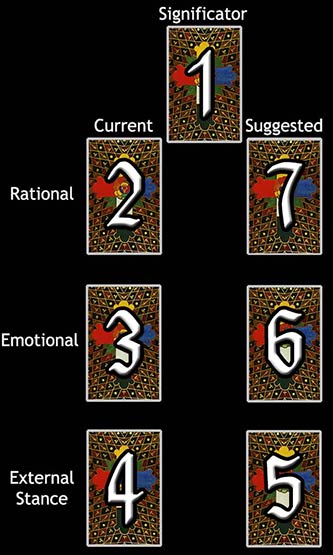
For the Path reading, one asks for suggestions how to behave properly to achieve a desired result. The Current column represents how the reader has been acting, and the Suggestedcolumn suggests how they should act to achieve a certain goal. The chart-like spread uses the standard three levels: Rational, Emotional, and External Stance (how one projects oneself outwardly). When comparing the Current and Suggested cards, the most important thing is to notice the differences between the two cards. It is these differences which hint at the behaviours that should be altered.
Card #1 is the significator, the card which should reflect the nature of the query and/or the desired outcome.
Card #2 shows the way the reader is and has been thinking. Card #7 suggests how to change the way one thinks to serve themselves better.
Card #3 suggests the reader's emotional attitude. Though it may seem difficult to manipulate one's own emotions, it can be done if one puts their mind to it. For example, acting a certain way such as smiling intently for a few minutes will lead the emotions to follow. When a person tries this, as silly as the exercise seems, they find this to evoke the emotion of happiness. For this reading, one should try to make themselves feel the way that Card #6 suggests.
External Stance means how one acts outwardly, how they hope others see them. Card #4 is about how the reader has been acting, while #5 indicates how they should act outwardly, for other people's sake. It is the differences between these cards that hint at what behaviour patterns should be altered.
Your Path Reading
Current |
The Significator 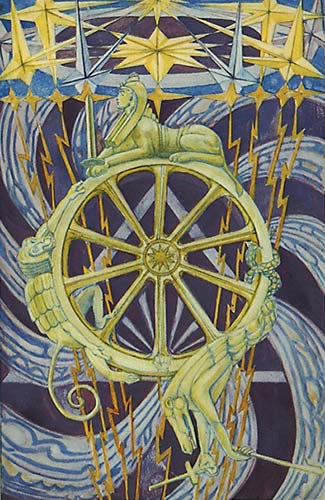 X – Fortune |
Suggested |
|
Thought |
 XVII – The Star |
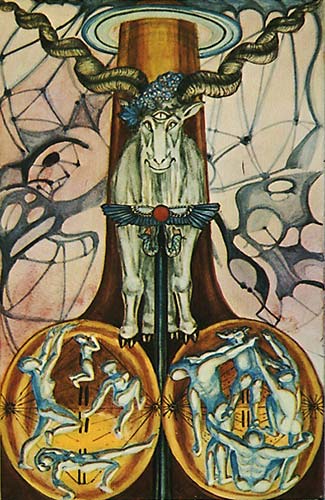 XV – The Devil |
|
Emotion |
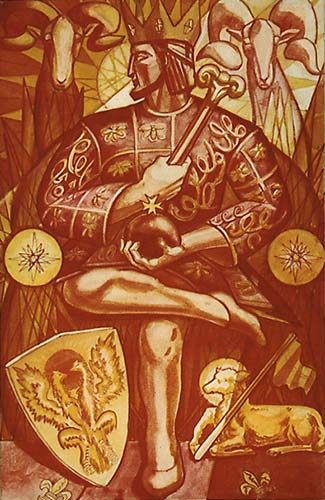 IV – The Emperor |
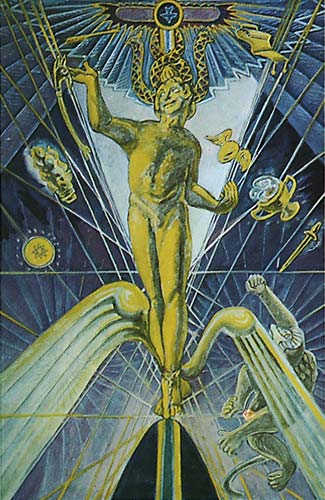 I – The Magus |
|
External Stance |
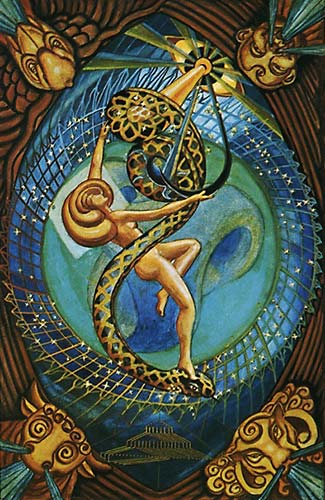 XXI – The Universe |
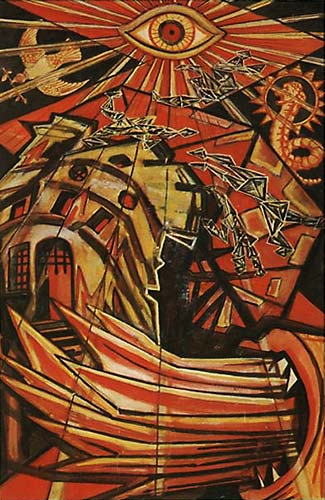 XVI – The Tower |
The Significator
X – Fortune
(Jupiter, Kaph)
Fortune represents the ever-turning wheel of fate, symbolising the cycles of change and the opportunities that arise through the interplay of forces. Associated with Kaph, the palm of the hand, this card signifies the ability to grasp the turning tides of fortune and shape one's destiny. Jupiter, the planet of expansion and abundance, imbues the card with optimism and growth.
The Wheel of Fortune is depicted as a cosmic mechanism, a rotating mandala of symbols and figures. At its centre is the ten-spoked wheel, representing the cyclical nature of existence and integration of opposites. Around it spin the Sphinx, the serpent, and the baboon, embodying stability, transformation, and the playful chaos of change. The wheel is connected to its spiritual counterpart above, signifying the promise of renewal and the unity of all things within the cosmic dance.
In Relationships: Fortune suggests change and new opportunities. It encourages you to embrace the unpredictable nature of love and remain open to its possibilities.
In Work: This card signifies a turning point and the potential for unexpected success. You are advised to seize opportunities and trust in the benevolent forces of change.
Spiritually: Fortune represents the acceptance of life's cycles and the wisdom gained through change. It calls you to embrace the flow of the universe and find peace in its rhythms.
When ill-dignified: Fortune warns of resistance to change, missed opportunities, or the chaotic forces of upheaval. You are advised to trust in the process of transformation and remain adaptable in the face of uncertainty.
Current Thoughts
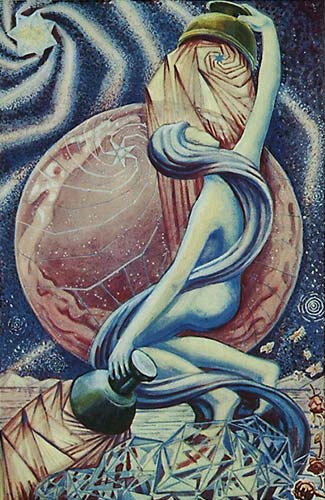
XVII – The Star
(Aquarius, Heh)
The Star represents hope, inspiration, and the flow of divine energy. Associated with Heh, the window, this card symbolises clarity and the opening of the soul to cosmic light. Aquarius, the zodiac of vision and humanitarian ideals, imbues the card with themes of enlightenment and universal connection.
The central figure is a nude woman, representing purity and vulnerability, pouring water from two vessels—one onto the earth and the other into a pool, symbolising the balance between spiritual and material realms. Behind her, a radiant star dominates the sky, surrounded by smaller stars, signifying guidance and hope. The background, rich with blues and violets, evokes the tranquillity of the natural world.
In Relationships: The Star suggests healing and renewed hope. It encourages you to trust in the flow of love and remain open to its guidance.
In Work: This card signifies inspiration and creative potential. You are advised to trust your intuition and align your efforts with a higher vision.
Spiritually: The Star symbolises a connection to the divine and the flow of universal energy. It calls you to share your gifts and have faith in the cosmic plan.
When ill-dignified: The Star warns of disillusionment, a loss of faith, or a failure to see one's potential. You are advised to reconnect with your inner light and trust in the process of renewal.
Suggested Thoughts
XV – The Devil
(Capricorn, Ayin)
The Devil symbolises bondage, materialism, and the potent, often misunderstood forces of desire and instinct. Associated with Ayin, the eye, this card invites a piercing vision into the illusions and structures that bind us. Capricorn, the zodiac of ambition and discipline, infuses the card with themes of mastery over material and earthly limitations.
The central figure is a goat before a phallic structure, symbolising generative power and material dominance. This card is seething with esoteric symbols of competition within a person. The background, webbed in deep, earthy tones, suggests the shadowy nature of the forces at play. The card is alive with energy, hinting at temptation and the potential for liberation.
In Relationships: The Devil represents intense, often obsessive attraction. It can warn of relationships rooted in control or dependency, urging you to assess whether your connections are serving your growth.
In Work: This card suggests material success, often achieved through relentless ambition. However, it warns of becoming enslaved by wealth or status and advises balancing ambition with higher values.
Spiritually: The Devil symbolises the necessity of confronting and integrating one's shadow self. It calls you to transcend material attachments and awaken to higher truths.
When ill-dignified: The Devil warns of oppression, excessive materialism, or destructive desires. You are advised to liberate yourself by recognising and overcoming illusions and self-imposed limitations.
Current Emotions
IV – The Emperor
(Aries, Tzaddi)
The Emperor represents the force of order, authority, and structure, embodying the disciplined energy required to manifest power and stability in the material world. He is linked to Tzaddi, symbolising insight and vision, representing the ability to perceive higher truths and take decisive action in alignment with divine will. As the astrological ruler Aries, he brings fiery determination and a pioneering spirit.
The Emperor sits on a ram-adorned throne, a clear nod to Aries, surrounded by a vibrant red background that speaks of his dynamic energy and martial authority. His sceptre, along with the orb and cross, symbolises the dominion of spirit over matter. At his feet lies the double eagle shield, representing far-reaching vision and the ability to soar above obstacles. The geometric forms surrounding him suggest the stability of order, while the lamb beneath his throne reminds us of the balance between power and protection.
In Relationships: The Emperor indicates a relationship rooted in stability, leadership, and mutual respect. It calls for clarity, honesty, and the willingness to establish healthy boundaries and foundations.
In Work: This card represents mastery over the material realm and the ability to build structures that endure. It encourages you to take charge of your destiny confidently and lead by example.
Spiritually: The Emperor signifies the grounding of spiritual energy into practical action. He calls you to embody your highest ideals in your daily life, manifesting divine will through disciplined effort.
When ill-dignified: The Emperor warns of rigidity, authoritarianism, or a misuse of power. You are cautioned to balance control with flexibility and lead with wisdom rather than dominance.
Suggested Emotions
I – The Magus
(Mercury, Beth)
The Magus of the Thoth deck radiates dynamic energy, the force of will and intellect that shapes reality. He corresponds to Beth, the house, signifying the power to create structure and form. Governed by Mercury, the Magus represents the mastery of communication, skill, and adaptation, embodying the ability to transmute thought into action.
The Magus stands amidst the elements he commands. Around him swirls the wand, cup, sword, and disk, each imbued with vibrant, electric energy. His figure exudes movement and control, as though he exists in a state of constant creation. Above him, the winged caduceus—the rod of Hermes—rises as a symbol of unity and transformation. The beam connecting heaven and earth signifies the infinite cycle of energy and potential.
In Relationships: The Magus suggests magnetic attraction and the ability to manifest deep, meaningful connections. It emphasises the importance of clear communication and aligning intentions with actions to nurture relationships.
In Work: This card signifies mastery and the ability to manifest success through focus and skill. It advises you to harness your talents and act with precision and intention to achieve your goals.
Spiritually: The Magus represents the awakening of personal power and the alignment of the microcosm and macrocosm. It is a call to take responsibility as a conscious creator in the divine play of existence.
When ill-dignified: The Magus warns of manipulation, overconfidence, or a scattering of energy. You are urged to examine your motives and ensure your actions serve the highest purpose, avoiding the temptation to misuse your gifts.
Current External Stance
XXI – The Universe
(Saturn, Earth, Tau)
The Universe is the culmination of the journey, symbolising integration, completion, and the harmonious union of opposites. Associated with Tau, the cross, this card reflects the materialisation of divine will and the synthesis of all forces. Saturn, the planet of structure and discipline, anchors the card in themes of order and manifestation.
The central figure is a nude woman, symbolising the perfected self, dancing within a ring of stars, on the head of an enormous serpent. She holds tools of creation in her hands, embodying mastery over all elements. Around her, the four cherubim faces—the lion, the eagle, the man, and the bull—represent the fixed signs of the zodiac and the balance of cosmic forces, as water flows from their noses and mouths. The background represents the infinite possibilities of the universe.
In Relationships: The Universe signifies fulfilment and the realisation of harmony. It encourages you to celebrate the unity and wholeness of your connections.
In Work: This card indicates the successful completion of a cycle and the achievement of long-term goals. You are advised to reflect on your accomplishments and prepare for new horizons.
Spiritually: The Universe symbolises enlightenment, the integration of all aspects of the self, and the realisation of cosmic unity. It calls you to embrace your place within the greater whole and celebrate the infinite potential of existence.
When ill-dignified: The Universe warns of stagnation, fear of completion, or an unwillingness to move forward. You are advised to release resistance and trust in the cycles of growth and transformation.
Suggested External Stance
XVI – The Tower
(Mars, Peh)
The Tower represents sudden upheaval, revelation, and the destruction of false structures. Associated with Peh, the mouth, this card conveys the power of truth to shatter illusions. Mars, the planet of force and conflict, infuses the card with explosive energy and transformative destruction.
The imagery is vivid and chaotic. A tall tower, struck by lightning, crumbles as flames consume it, symbolising the collapse of rigid, outdated systems. Figures fall from the tower, illustrating the inevitability of change and the humbling of ego. The colours are fiery and intense, reflecting the raw energy of destruction. Amidst the chaos, the lion-serpent Yaldabaoth and a dove representing the Holy Spirit suggest a transformation brought about by hidden wisdom revealed by divine grace.
In Relationships: The Tower indicates sudden changes or disruptions. It may signify a breakup or the dismantling of illusions, allowing for greater honesty and authenticity.
In Work: This card signals upheaval or the collapse of established structures. You are advised to embrace change as an opportunity for rebuilding stronger foundations.
Spiritually: The Tower symbolises enlightenment through the destruction of illusions. It calls you to surrender to the transformative power of truth and embrace the freedom that follows.
When ill-dignified: The Tower warns of resistance to change or the denial of necessary upheaval. You are advised to confront uncomfortable truths and allow the process of transformation to unfold.