
Relationship Spread #2
Difficulty: Easy
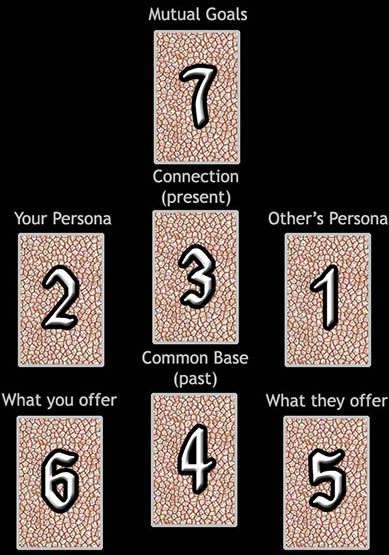
This relationship spread focuses more on the common ground of the relationship, with three cards in the middle column showing the common ground. The middle column essentially displays the past, present, and future of the relationship.
Card #4 stands for the common base of the relationship, which may be thought of as the past events which have shaped their characters, bringing them together. The current connection that binds them together is Card #3, indicating the values shared. Card #7 implies the common goals that would keep the pair together moving into the future.
The columns on either side show what each partner brings to the table. Remember, relationships need not be romantic, and the partners could even be groups rather than individuals. In this layout, the other person is on the left-hand side and the reader on the right.
Cards #1 & #2 indicate the separate personalities of each member of the relationship. These cards form a sort of bridge with the cards beneath them, #5 & #6, which show the qualities that each partner offers the other person, and thus to the relationship as a whole.
Your Relationship #2 Reading
Mutual Goals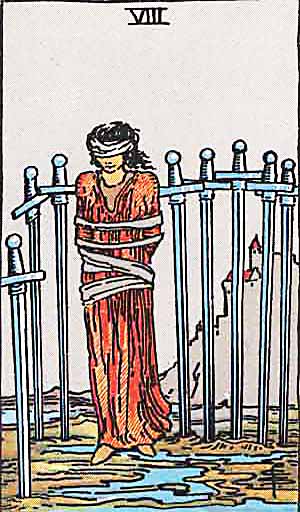 |
||
Your Qualities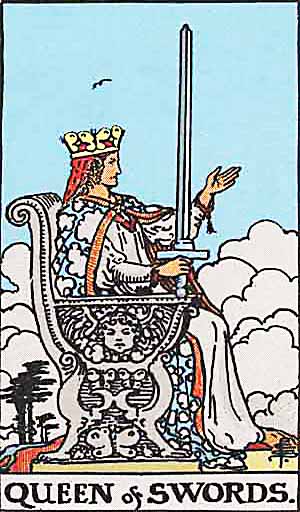 |
Connection (Present)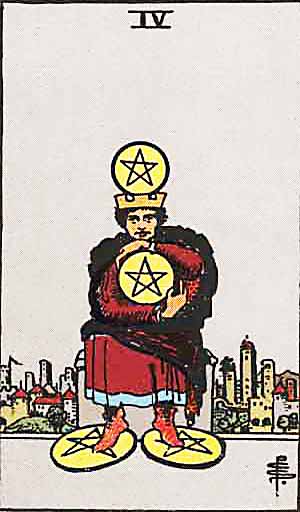 |
Others' Qualities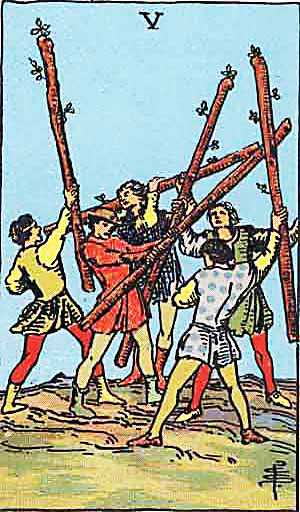 |
What You Bring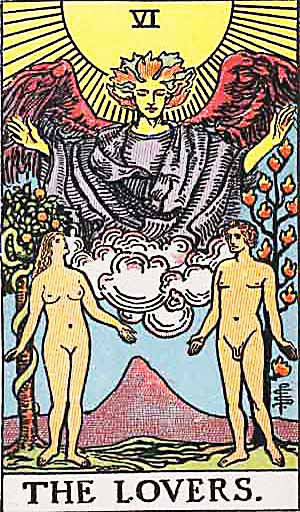 |
Common Base (Past)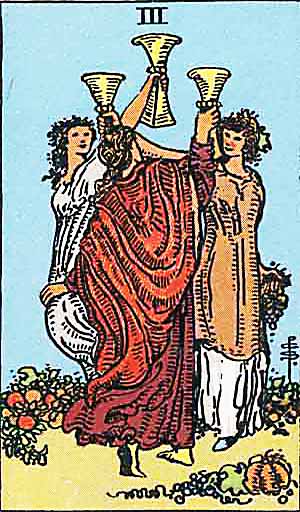 |
What They Bring 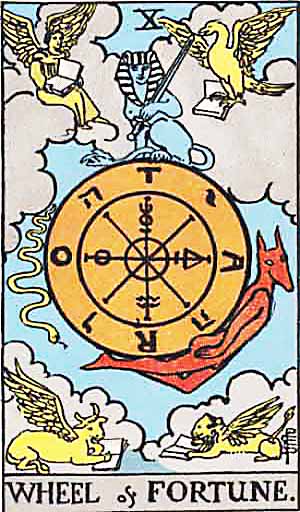 |
7: Mutual Goals
Eight of Swords
The Eight of Swords represents restriction, entrapment, and mental imprisonment. This card suggests you feel trapped or bound by a situation, often because of limiting beliefs, fears, or self-doubt. The image of a blindfolded figure bound and surrounded by swords indicates a state of confusion, where you can't see a way out of your problems or challenges. The Eight of Swords highlights how the mind can create a sense of imprisonment, making obstacles seem insurmountable, even when they may not be. It's a card that invites you to examine the mental barriers you've placed on yourself and realise that you may have more freedom than you perceive.
This card suggests you may feel overwhelmed or constrained by your circumstances, but the key message is that these limitations are often self-imposed. The swords represent mental conflict and anxiety, and the blindfolded figure symbolises a lack of understanding. The Eight of Swords is a reminder that the first step towards freedom is changing the way you perceive the situation. By confronting fears, challenging negative thoughts, and gaining clarity, you can free yourself from this mental prison.
In Relationships: The Eight of Swords suggests a situation where you feel trapped, restricted, or emotionally bound. This could indicate feelings of helplessness or fear that prevent you from moving forward. The Eight of Swords may also represent a situation where you feel stuck due to insecurities or fears about opening up or making changes in the relationship. The card encourages you to examine your mental and emotional limitations and recognise that these barriers are not insurmountable. It may also suggest that you need to free yourself from old wounds, negative beliefs about love, or toxic patterns to move forward in a healthier and more fulfilling way.
In Work: The Eight of Swords indicates you may feel trapped in your current job, position, or professional situation. You may feel like you have no options or are constrained by circumstances beyond your control. The Eight of Swords suggests you are experiencing a mental block, feeling stuck, or doubting your abilities to break free from your current work situation. This card encourages you to challenge your own thinking and recognise that the restrictions you feel are often mental rather than physical. The Eight of Swords advises you to seek new perspectives, find creative solutions, and have the confidence to move past your self-imposed limitations to achieve career growth and fulfilment.
Spiritually: The Eight of Swords represents a state of spiritual confusion or entrapment. You may struggle with limiting beliefs, fear, or doubt preventing you from embracing your spiritual path. This card suggests you may feel disconnected from your spiritual practice or trapped in a cycle of negative thought patterns. The Eight of Swords invites you to examine your mental state and recognise that your limitations may be self-created. It encourages you to release these fears, allowing yourself to move along your spiritual path with greater freedom and openness.
3: Connection
Four of Pentacles, Reversed
The Four of Pentacles represents security, stability, and the need to protect one's material resources. This card embodies the energy of holding on to what has been gained, whether it's financial wealth, possessions, or personal achievements. The figure on the card clutches their pentacles, symbolising the desire to secure material wealth and accomplishments. While this can signify a solid foundation and a sense of security, it can also indicate a fear of loss, possessiveness, or a reluctance to release control.
Reversed, the Four of Pentacles suggests excessive possessiveness, insecurity, or an unhealthy attachment to material wealth. You may be hoarding resources out of fear or may be struggling with financial instability or lack. This reversal may indicate that your focus on security creates rigidity, preventing you from adapting to new opportunities or embracing necessary changes. It may also suggest a fear of loss, an unwillingness to take risks, or an overemphasis on material concerns to the detriment of personal growth or relationships. The Four of Pentacles reversed urges you to let go of control, be open to change, and find a balance in how you approach the material world.
In Relationships: The Four of Pentacles may indicate a tendency to be overly protective, possessive, or guarded. You may be holding onto old wounds or fears of abandonment, preventing you from opening up to a partner. Alternatively, the card may suggest a relationship built on security and stability, but lacking emotional depth or growth. You may need to examine whether you are holding onto a relationship out of fear of change or loss, rather than mutual love and growth. The Four of Pentacles encourages you to find a balance between maintaining security and allowing for vulnerability, trust, and emotional intimacy within the relationship.
In Work: The Four of Pentacles suggests you may be focused on maintaining financial stability or securing your position. This card indicates you are likely working hard to protect your material resources or professional achievements, and may be focused on building a solid foundation for the future. While the card encourages you to safeguard your progress, it warns against becoming too rigid, controlling, or attached to the status quo. The Four of Pentacles could indicate a fear of taking risks or embracing change, which could limit your growth and opportunities for advancement. The card invites you to evaluate whether your desire for security prevents you from pursuing new opportunities or adapting to changes in your career.
Spiritually: The Four of Pentacles can represent a need to examine one's attachment to material concerns or the fear of losing control. You may be clinging too tightly to your worldly possessions or financial security, which could hinder your growth. This card suggests that abundance comes not from holding on to material things, but from embracing a mindset of openness, generosity, and trust: a growth mindset. The Four of Pentacles invites you to consider whether you allow your fears or attachment to material wealth to block your spiritual path. It encourages you to release any fear-based attachments and trust in the flow of abundance that can come from letting go.
4: Common Base
Three of Cups, Reversed
The Three of Cups is a card of celebration, community, and emotional fulfilment. It represents friendship, reunions, and the bonds that connect us to others. This card depicts three women raising their cups in a celebratory toast, symbolising the collective joy from shared experiences and emotional connection. The Three of Cups is about coming together with others, celebrating achievements, and embracing the support and love of close-knit relationships. It invites you to recognise the importance of community, connection, and the joy of celebrating life's moments with others.
Reversed, the Three of Cups can indicate disharmony in friendships or a lack of emotional connection within a group or community. You may feel disconnected from others or experience a lack of support from your social circle. This card reversed suggests you may need to address relationship issues, such as misunderstandings or conflicts with friends or loved ones. It can also point to overindulgence or a focus on superficial connections that may detract from deeper emotional fulfilment. The reversed Three of Cups invites you to re-establish connections, find balance in your social life, and seek out relationships that bring emotional nourishment.
In Relationships: The Three of Cups signifies joy, celebration, and harmony. It can indicate a time of emotional fulfilment within a relationship when both partners share mutual respect, fun, and emotional connection. This card suggests love is flowing freely, and you and your partner are in a time of mutual happiness and affection. For singles, the Three of Cups suggests that social gatherings, celebrations, or events could lead to a meaningful connection or the blossoming of new love. It can also point to the importance of maintaining close friendships and nurturing relationships outside of romance, as these connections will enrich your emotional world.
In Work: The Three of Cups signifies teamwork, collaboration, and shared success. This card suggests you are working well with others, and your efforts are supported by a network of colleagues, friends, or partners. The Three of Cups highlights the power of community and collaboration in achieving professional goals, encouraging you to celebrate milestones and successes with others. It may also indicate a time when you receive recognition or support from a team, group, or network, leading to greater opportunities for growth and advancement. The card encourages you to value the contributions of those around you and celebrate collective achievements.
Spiritually: The Three of Cups represents a time of emotional and spiritual fulfilment through connection with others. It suggests you may find strength and insight in community, whether through spiritual groups, friends, or shared practices. This card highlights the importance of emotional support, group experiences, and collective celebrations in your spiritual journey. The Three of Cups encourages you to honour your spiritual connections with others and seek out groups or communities that align with your spiritual values. It also signifies a time of joyous spiritual discovery and the emotional rewards of sharing your path with like-minded individuals.
2: Your Qualities
Queen of Swords, Reversed
The Queen of Swords represents intellect and independence. This card embodies a woman who is sharp, perceptive, and unafraid to speak her mind. With a keen intellect and a clear vision, the Queen of Swords can cut through confusion and see the truth of any situation. She represents mental clarity, objectivity, and a rational approach to problem-solving. The Queen holds her sword with authority, signifying her ability to assert herself and set boundaries. She is calm and composed, yet her mind is quick and discerning. Her energy is about using logic, reason, and communication to navigate life's challenges.
Reversed, the Queen of Swords suggests a time of confusion or miscommunication. You may be struggling to think clearly, feeling emotionally overwhelmed, or having difficulty setting boundaries. The reversed Queen of Swords can also indicate harsh judgement or a tendency to cut others off, using intellect to distance oneself from emotions or relationships. There may be a lack of emotional depth or an over-reliance on logic, leading to coldness or detachment in relationships. You are encouraged to examine your communication style and restore balance between intellect and emotion. The reversal of this card suggests that while you may be sharp, you need to address any emotional blockages or misunderstandings that may hinder your progress.
In Relationships: The Queen of Swords represents clear communication and an intellectual connection. This card suggests you may need to approach your romantic life honestly and directly. You may be called to express your needs, desires, and boundaries without hesitation. The Queen of Swords reminds you to maintain independence and not lose yourself in a relationship. It can also indicate the need to address misunderstandings or miscommunications and approach emotional situations logically. The Queen of Swords advises to balance intellect with emotional sensitivity in matters of love.
In Work: The Queen of Swords symbolises clear thinking, effective communication, and strategic planning. You may be in a position where you are required to make decisions based on logic, objective assessment, and insight. This card suggests trusting your intellectual abilities, deciding confidently, and communicating clearly with others. The Queen of Swords can also indicate a role where you must serve as a leader, counsellor, or advisor, using your wisdom and clear judgement to guide others. It may also suggest the need to remain professional and composed, using reason to handle any difficult situations that arise. The Queen of Swords reminds you to be independent and self-sufficient in your career, relying on your abilities rather than seeking validation from others.
Spiritually: The Queen of Swords represents inner wisdom. You may be seeking truth in your spiritual journey, and this card urges you to trust your insights and inner guidance. The Queen of Swords asks you to approach spirituality with objectivity and discernment, seeking wisdom from trusted sources while filtering out distractions or illusions. This card can also indicate a time of spiritual growth that requires a balance of intellect and intuition, where clear, focused thinking will help you navigate your path. The Queen of Swords represents the ability to cut through spiritual confusion and gain a deeper understanding of your true purpose.
1: Their Qualities
Five of Wands
The Five of Wands represents conflict, competition, and the challenges that arise from differing opinions or approaches. It indicates tension or struggle, often within a group or community. Depicted as multiple figures engaged in a chaotic situation, each holding a wand and vying for position, the Five of Wands symbolises conflict that arises from differences in perspective, ambition, or goals. However, this card does not suggest that the conflict is destructive, but an opportunity for growth and learning through challenges.
The Five of Wands often points to an environment of competition or rivalry, where individuals are trying to assert themselves or stand out. This card asks you to assess how you respond to challenges and whether you participate in unnecessary conflict. The energy of the Five of Wands can feel tense and frustrating, but it can also be a catalyst for innovation, as these challenges often push people to think creatively and find new ways to assert themselves. It suggests that conflict can be overcome with cooperation and a willingness to understand differing viewpoints.
In Relationships: The Five of Wands indicates a time of tension or conflict. This could manifest as disagreements, misunderstandings, or a lack of alignment between partners. It may also suggest competition, whether it's between romantic interests or external pressures affecting the relationship. The Five of Wands asks you to examine the nature of these conflicts—are they really important, or are they distractions? It may indicate that you and your partner need to find common ground and address underlying issues to move forward. This card can also indicate rivalry, whether dealing with external competition or navigating emotional struggles within the relationship.
In Work: The Five of Wands signals a competitive or challenging work environment. You may be facing conflict with colleagues, managers, or even clients, or there may be a struggle to assert your position in a competitive field. This card suggests that, while challenges are present, they are not necessarily insurmountable. The Five of Wands encourages you to stay focused on your goals and use the competition as a motivator for personal growth and innovation. Rather than being discouraged by conflict, you are urged to find ways to collaborate or think creatively to stand out from the crowd. The Five of Wands can also point to a need to choose your battles wisely.
Spiritually: The Five of Wands represents inner conflict or struggles in finding harmony with one's beliefs or spiritual path. This card may indicate that you are facing challenges in reconciling different spiritual practices or may feel torn between different aspects of your spiritual self. The Five of Wands suggests that conflict is part of the spiritual journey, but can also provide valuable lessons in growth, strength, and clarity. This card asks you to examine how you respond to inner and outer conflict and to integrate differing views or beliefs into a more cohesive understanding. It encourages you to embrace challenges as opportunities to refine your spiritual practice, understanding that discord can lead to greater personal and spiritual evolution.
6: What You Bring
VI – The Lovers
5: What They Bring
X – The Wheel of Fortune
The Wheel of Fortune represents cycles, fate, destiny, and change. The tenth card of the Major Arcana embodies the ever-turning wheel of life, where circumstances shift unpredictably, and the forces of fortune and destiny influence our lives. The Wheel features symbols such as the creatures of Ezekiel's vision and the Sphinx, representing the ongoing movement of time and the interplay between fate and free will. The card speaks to the cyclical nature of existence, where moments of fortune and misfortune rise and fall, reminding us that no situation lasts forever.
The Wheel of Fortune signifies that change is inevitable, and you are entering a phase where luck, external forces, or destiny will play a key role in your life. This card often points to a turning point, suggesting that a shift in circumstances is on the horizon. The Wheel of Fortune encourages you to embrace the flow of life, trust in the process, and understand that everything moves in cycles. It calls for acceptance of both the highs and lows, for they are both integral parts of the journey.
In Relationships: The Wheel of Fortune signifies that changes are coming, often unexpectedly. It may indicate a turning point in a romantic relationship, where new dynamics or events will shift the course of the connection. This card suggests you should be open to the ebb and flow of emotions, as relationships go through cycles of growth, transformation, and occasional turmoil. The Wheel reminds us that love is not static, and that fate or timing may play a crucial role in romantic endeavours. It encourages flexibility and acceptance, knowing that changes, while sometimes difficult, bring opportunities for renewal and growth.
In Work: The Wheel of Fortune suggests change is imminent, whether it's a shift in job, career path, or professional circumstances. This card can indicate that your efforts are about to bear fruit or external forces, such as a new opportunity or unexpected event, will alter the course of your professional journey. The Wheel of Fortune encourages you to stay adaptable, as fortune may favour you or present challenges that require a shift in perspective. It also signifies that luck or timing will be a factor, and you should be ready to seize opportunities that arise.
Spiritually: The Wheel of Fortune speaks to the interconnectedness of all things and the cyclical nature of life. It reminds you that everything is in constant motion, and that spiritual growth often comes through periods of both abundance and hardship. This card encourages you to trust in the divine timing of your journey, knowing that each phase, whether of challenge or ease, has a lesson to offer. The Wheel of Fortune also invites you to recognise that fate plays a role in your spiritual path and be open to the mysteries of the universe, even when things are beyond your control.